Showing posts with label Knowledge. Show all posts

Sunday, 31 December 2017

“How much knowledge does the understanding in words contain?"

Words are symbolic indications and/or conveyors of meaning and are not that meaning in themselves.

Meaning is found, stored, and manipulated in our minds. This is why different languages are capable, in varying degrees of usefulness, to convey meaning which is very similar to that found via the symbols of any other.


It is also the reason why there are words indicating meaning that are not found in other languages; or, if found in a different language, the other language requires more of its own structure, dynamics, and resonance to convey the same meaning.


For example: the words ‘déjà vu’ in French are found in German ‘schon gesehen’ and in English ‘already seen’, but these phrases do not convey the full meaning found in the French version. To counter this deficit, their meaning in other languages must be ‘constructed’ out of or ‘fortified’ by the careful use of longer strings of symbols. This additional construction and/or fortification may even fail at times. This is often where the word phrase from a different language is simply added to the language in which the concept is missing.

This same situation is found in the literature of many languages. The words used to convey meaning are condensed and may contain more meaning than is usually the case. In this regard, even the person reading/hearing the words may not possess the competence necessary to catch this condensed meaning in its fullness.

Mathematical expressions, albeit more precise, are also indications of meaning. They are more robust in their formulation, but at ever-increasing depth and scope, even they may fail to reliably or conveniently convey meaning.


Our understanding of what words mean is not always accurate, but where our mutual understanding of the meaning of words overlaps, and the degree to which they overlap, is where their meaning can be shared.

Our own personal understanding of words is measured by our ability to apply their meaning in our lives.
There is also a false meme, which I would like to clarify.

“Knowledge is Power!”

It is wrongly said that ‘Knowledge is power’. The truth is another: Knowledge is the measure of usefulness of what we understand and is the only true expression of its ‘power’.

The value of Knowledge is found in its usefulness and not in its possession.

My Quora Answer

Thursday, 11 May 2017

Is Real World Knowledge More Valuable Than Fictional Knowledge?

No.

Here an excerpt from a short summary of a paper I am writing that provides some context to answer this question:

What Knowledge is not:

Knowledge is not very well understood so I'll briefly point out some of the reasons why we've been unable to precisely define what knowledge is thus far. Humanity has made numerous attempts at defining knowledge. Plato taught that justified truth and belief are required for something to be considered knowledge.

Throughout the history of the theory of knowledge (epistemology), others have done their best to add to Plato's work or create new or more comprehensive definitions in their attempts to 'contain' the meaning of meaning (knowledge). All of these efforts have failed for one reason or another.

Using truth value and 'justification’ as a basis for knowledge or introducing broader definitions or finer classifications can only fail.

I will now provide a small set of examples of why this is so.

Truth value is only a value that knowledge may attend.

Knowledge can be true or false, justified or unjustified, because

knowledge is the meaning of meaning

What about false or fictitious knowledge? [Here’s the reason why I say no.]

Their perfectly valid structure and dynamics are ignored by classifying them as something else than what they are. Differences in culture or language even make no difference, because the objects being referred to have meaning that transcends language barriers.

Another problem is that knowledge is often thought to be primarily semantics or even ontology based. Both of these cannot be true for many reasons. In the first case (semantics):

There already exists knowledge structure and dynamics for objects we cannot or will not yet know.

The same is true for objects to which meaning has not yet been assigned, such as ideas, connections and perspectives that we're not yet aware of or have forgotten. Their meaning is never clear until we've become aware of or remember them.

In the second case (ontology): collations that are fed ontological framing are necessarily bound to memory, initial conditions of some kind and/or association in terms of space, time, order, context, relation,... We build whole catalogues, dictionaries and theories about them: Triads, diads, quints, ontology charts, neural networks, semiotics and even the current research in linguistics are examples.

Even if an ontology or set of them attempts to represent intrinsic meaning, it can only do so in a descriptive ‘extrinsic’ way. An ontology, no matter how sophisticated, is incapable of generating the purpose of even its own inception, not to mention the purpose of the objects to which it corresponds.

The knowledge is not coming from the data itself, it is always coming from the observer of the data, even if that observer is an algorithm.

Therefore ontology-based semantic analysis can only produce the artefacts of knowledge, such as search results, association to other objects, 'knowledge graphs' like Cayley,…

Real knowledge precedes, transcends and includes our conceptions, cognitive processes, perception, communication, reasoning and is more than simply related to our capacity of acknowledgement.

In fact knowledge cannot even be completely systematised; it can only be interacted with using ever increasing precision.

[For those interested, my summary is found at: A Precise Definition of Knowledge - Knowledge Representation as a Means to Define the Meaning of Meaning Precisely: http://bit.ly/2pA8Y8Y

Monday, 31 August 2015

A Holon's Topology, Morphology, and Dynamics (2a)

A Holon's Topology, Morphology, and Dynamics (2a)

This is the second video of a large series and the very first video in a mini-series about holons. In this series I will be building the vocabulary of holons which in turn will be used in my knowledge representations.
The video following this one will go into greater detail describing what you see here and will be adding more to the vocabulary.

This is the second video of a large series and the very first video in a mini-series about holons. In this series I will be building the vocabulary of holons which in turn will be used in my knowledge representations.

#Knowledge #Wisdom #Understanding #Insight #Learning #MathesisUniversalis #ScientiaUniversalis #Holons   #BigData  

Tuesday, 3 February 2015

Science As a New Tower of 'Babble'

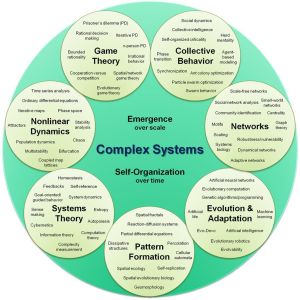
1024px-Complex_systems_organizational_map1280px-Complexity_Map.svg 

Science As a New Tower of 'Babble'
Complexity - a patchwork quilt of misunderstanding and confusion tied together 'by hook or by crook'.
https://en.wikipedia.org/wiki/By_hook_or_by_crook

Complex systems are the result of our collective blindness to the simple interconnectedness of our universe.

Why is the emerging view of our universe - no longer a Cosmological and Cosmogonic garden of the good, true and beautiful - now turning into this phantasm of complexity?

Where did we go wrong?
Was it the creation and maintaining of the expectation that we could comprehend and grasp the whole of our Cosmos within one perspective?

Were the applications of the science we created so profit bearing that we began to take more than our fare share?

Was it the tempo at which our scientists - not even slowed down by the ethical and moral considerations which constitute our navigation systems down the roads of evolution - that have brought us to this place much too soon and with so much needless suffering (for animals and humans)?

Are we to continue abandoning our organic (and real) ascendancy for artificial (and synthetic) correlates?

The ends are NOT justified by their means! They are determined by them.

https://en.wikipedia.org/wiki/Complex_systems

#Knowledge #Wisdom #Understanding #Learning #Insight #Awaken #AwakenNow #Trendy #AI #OI #ArtificialIntelligence #OrganicIntelligence #ScienceRunAmok #TechnologyRunAmok
Image1:
Hiroki Sayama, D.Sc. - Created by Hiroki Sayama, D.Sc., Collective Dynamics of Complex Systems (CoCo) Research Group at Binghamton University, State University of New York

Image2:
By Brian Castellani (Own work) [CC BY-SA 3.0 (http://creativecommons.org/licenses/by-sa/3.0)], via Wikimedia Commons