Saturday, 7 May 2022

OUR LIBRARY - MATHESIS UNIVERSALIS!

This collection of books is a small, but growing example of the millions of books, journals, periodicals, and academic papers we are currently tracking and indexing. We are updating this library constantly. Please return often and review this library as it evolves.

This library is the first step on our way to making Mathesis Universalis (the long-sought search for a unifying principle in all that we know and experience) a reality. Soon our knowledge representations, in their many forms, will be accessible from the pop-up dialogues which appear when you click/tap on a book's entry in the overview you see. Other types of knowledge sources; such as social media activity, websites, E-Mails, audio, video,... are also going to be included in our tracking and indexing system.

I, Carey G. Butler, have been working on this idea since 1989 during my study of Foundational Mathematics and Complex Analysis. I then moved to Germany in 1990 to continue my study (this time in the original German language) of many German mathematicians and philosophers such as Carl Friedrich Gauss, Bernhard Riemann, Gottfried Wilhelm Leibniz,... During that first year I began to formalise the idea as I began to learn the German language more intensively.

The journey has been a long one and was finally conceptually refined in March of 2009. The journey has taken many, many turns in the years since. I have made several key discoveries in mathematics, philosophy, and linguistics along the way which I, due to my concerns about priority, have not yet published. A few of these discoveries are documented elsewhere though, but I have been very careful to withhold many aspects of their details until I was able to find and/or adapt current technologies to bring them to a useful expression and application in their fullness. I was confronted with many obstacles and challenges, but I never gave up. For more information about my plans, please visit our website at Mathesis Universalis in English or Mathesis Universalis auf Deutsch.

As it stands, we could have created this library application a year ago. It is, in itself, nothing very special for programmers who know how to build applications like it. However, as we developed and tested the predecessor to this application, it soon became very clear that the sheer volume of data being manipulated was creating increasing demands on the conventional technology we were using at the time. Our concerns about processing time, network speed, and infrastructural demands forced us to step back and create a better foundation which could be scaled to any degree. We have spent the last 8 months (August 2021 - April 2022) building a 'symphony' of cloud applications and an infrastructure which is now fast, reliable, and scalable.

Towards that aim, this library represents the 'orchestration' of a collection of cloud apps we created or have forked and modified for our purposes that is distributed over several servers. Its backend is primarily driven by a distributed Couchbase database to store and to manipulate the massive amount of data. Also other kinds of databases are implemented for temporary storage or for the frontend's presentation and housekeeping.

We are currently developing a Progressive Web App which will use this library as one of its sources to present our knowledge representation.

Finally, after 13 years of investment of all kinds and, on the 8th birthday of one of my most important discoveries ('We Have a Heartbeat'),...

The stage is set... let the play begin!

The stage is set... let the play begin!


Monday, 9 April 2018

Is the P=NP Problem an NP Problem?

What I’m going to say is going to be unpopular, but I cannot reconcile my own well-being without giving you an answer to this problem from my perspective.

My only reason for reluctantly writing this, knowing what kind of reaction I could receive is, because I abhor that some of the best minds on our planet are occupying themselves with this problem. It pains me to no end to see humanity squandering its power for a problem that, as it is currently framed, is unanswerable. It goes further than this though. There will come a time when questions such as this one will be cast upon the junk heap of humanity’s growth throughout history. It will take its rightful place along such ideas as phrenology.

Here’s why I say this:

The problem is firmly and completely embedded in Functional Reductionism. I say this, because the problem’s framing requires us to peel away the contextual embedding of the problems which it is supposed to clarify.

This is just one of its problems. Here’s another:

Since the data for this problem (and those like it) are themselves algorithms, they are compelled to be functionally reduced versions of mind problem solving (varying types of heuristics and decision problems) which reduces the problem’s causal domain and its universe of discourse even further. How can a specification based upon functionally reduced data be again used as data for the problem’s solution in the first place?

That means that this problem has no independent existence nor causal efficacy. Everywhere I have looked at this problem, the definitions of NP-Hard and NP-Complete do not lead to proving anything useful. We cannot ‘generalise’ the mind by reducing it to some metric of complexity. Complexity is also not how the universe works as Occam’s Razor[1] shows.

I am prepared to defend my position should someone have the metal to test me on this. Another thing: I wish I could have left this alone, but we all need to wake up to this nonsense.

[1] http://bit.ly/2GHbRkW How Occam's Razor Works

[Quora]
http://bit.ly/2EuRdP3

Friday, 30 March 2018

Getting Hypertension About Hyperreals

(Links below)

This system is quite interesting if we allow ourselves to talk about the qualities of infinite sets as if we can know their character completely. The problem is, any discussion of an infinite set includes their definition which MAY NOT be the same as any characterisation which they may actually have.

Also, and more importantly, interiority as well as exteriority are accessible without the use of this system. These 'Hyperreals' are an ontological approach to epistemology via characteristics/properties we cannot really know. There can be no both true and verifiable validity claim in this system.

https://www.youtube.com/watch?v=rJWe1BunlXI (Part1)
https://www.youtube.com/watch?v=jBmJWEQTl1w (Part2)

Sunday, 31 December 2017

“How much knowledge does the understanding in words contain?"

Words are symbolic indications and/or conveyors of meaning and are not that meaning in themselves.

Meaning is found, stored, and manipulated in our minds. This is why different languages are capable, in varying degrees of usefulness, to convey meaning which is very similar to that found via the symbols of any other.


It is also the reason why there are words indicating meaning that are not found in other languages; or, if found in a different language, the other language requires more of its own structure, dynamics, and resonance to convey the same meaning.


For example: the words ‘déjà vu’ in French are found in German ‘schon gesehen’ and in English ‘already seen’, but these phrases do not convey the full meaning found in the French version. To counter this deficit, their meaning in other languages must be ‘constructed’ out of or ‘fortified’ by the careful use of longer strings of symbols. This additional construction and/or fortification may even fail at times. This is often where the word phrase from a different language is simply added to the language in which the concept is missing.

This same situation is found in the literature of many languages. The words used to convey meaning are condensed and may contain more meaning than is usually the case. In this regard, even the person reading/hearing the words may not possess the competence necessary to catch this condensed meaning in its fullness.

Mathematical expressions, albeit more precise, are also indications of meaning. They are more robust in their formulation, but at ever-increasing depth and scope, even they may fail to reliably or conveniently convey meaning.


Our understanding of what words mean is not always accurate, but where our mutual understanding of the meaning of words overlaps, and the degree to which they overlap, is where their meaning can be shared.

Our own personal understanding of words is measured by our ability to apply their meaning in our lives.
There is also a false meme, which I would like to clarify.

“Knowledge is Power!”

It is wrongly said that ‘Knowledge is power’. The truth is another: Knowledge is the measure of usefulness of what we understand and is the only true expression of its ‘power’.

The value of Knowledge is found in its usefulness and not in its possession.

My Quora Answer

Wednesday, 13 December 2017

Is using an heuristic to make a decision logically sound?

By its very definition it is logical - even if that logic may be abstract or incomplete.

Whether it is sound (logically) or not, is determined by what is called a validity test.


Here is a diagram based upon traditional logic. Looking these in a more detailed way:


With an heuristic, its ‘validity’ is solely determined by its usefulness to a purpose. The measure or nature of that usefulness is how effective it is.

Answer on Quora

Wednesday, 15 November 2017

Lateral Numbers - How 'Imaginary Numbers' May Be Understood

First, allow me to rename theses numbers during the remainder of this post to lateral numbers, in accordance to the naming convention as was recommended by Gauss. I have a special reason for using this naming convention. It will later become apparent why I’ve done this.

If we examine lateral numbers algebraically, a pattern emerges:

$i^0 = 1$

$i^1 = i$

$i^2 = -1$

$i^3 = -i$

$i^4 = (i^2)^2 = (-1)^2 = 1$

$i^5 = i \cdot i^4 = i$

$i^6 = i^2 \cdot i^4 = (-1)(1) = -1$

$i^7 = i^2 \cdot i^5 = (-1)i = -i$

$i^8 = i^4 \cdot i^4 = (1)(1) = 1$


When we raise lateral numbers to higher powers, the answers do not get higher and higher in value like other numbers do. Instead, a pattern emerges after every 4th multiplication. This pattern never ceases.

All other numbers, besides laterals, have a place on what currently is called the ‘Real number line’.
I qualify the naming of the Real Numbers, because even their conceptualisation has come into question by some very incisive modern mathematicians. That is a very ‘volatile’ subject for conventional mathematicians and would take us off on a different tangent, so I’ll leave that idea for a different post.

If we look for laterals on any conventional Real number line, we will never ‘locate’ them. They are found there, but we need to look at numbers differently in order to ‘see’ them.

Lateral numbers solve one problem in particular: to find a number, which when multiplied by itself, yields another negative number.

Lateral numbers unify the number line with the algebraic pattern shown above.


2 is positive and, when multiplied by itself, yields a positive number. It maintains direction on the number line.


When one of the numbers (leaving squaring briefly) being multiplied is negative, the multiplication yields a negative number. The direction ‘flips’ 180° into the opposite direction.
Multiplying -2 by -2 brings us back to the positive direction, because of the change resulting in multiplying by a negative number, which always flips our direction on the number line.


So, it appears as if there’s no way of landing on a negative number, right? We need a number that only rotates 90°, instead of the 180° when using negative numbers. This is where lateral numbers come into play.
If we place another lateral axis perpendicular to our ‘Real’ number line, we obtain the desired fit of geometry with our algebra.

When we multiply our ‘Real’ number 1 by i, we get i algebraically, which geometrically corresponds to a 90° rotation from 1 to i.
Now, multiplying by i again results in i squared, which is -1. This additional 90° rotation equals the customary 180° rotation when multiplying by -1 (above).


We may even look at this point as if we were viewing it down a perpendicular axis of the origin itself (moving in towards the origin from our vantage point, through the origin, and then out the back of our screen).
[If we allow this interpretation, we can identify the 'spin' of a point around the axis of its own origin! The amount of spin is determined by how much the point moves laterally in terms of i.
We may even determine in which direction the rotation is made. I'll add how this is done to this post soon.]
Each time we increase our rotation by multiplying by a factor of i, we increase our rotation another 90°, as seen here:

and,


The cycle repeats itself on every 4th power of i.
We could even add additional lateral numbers to any arbitrary point. This is what I do in my knowledge representations of holons. For example a point at say 5 may be expressed as any number of laterals i, j, k,… simply by adding or subtracting some amount of i, j, k,...:

5 + i + j +k +…
Or better as:
[5, i, j, k,…]

Seeing numbers in this fashion makes a point n-dimensional.

Saturday, 23 September 2017

Strictly Speaking Can't! Natural Language Won't?

Physics is only complex, because it's in someone's interest to have it that way. The way to understanding, even if you don't understand science, was paved with words. Even if those words led only to a symbolic form of understanding.

Common ordinary language is quite capable of explaining physics. Mathematics is simply more precise than common language. Modern Mathematics pays the price for that precision by being overly complex and subservient to causal and compositional relations. These are limitations that metaphysics and philosophy do not have.

Words in language have a structure that mathematics alone will never see as it looks for their structure and dynamics in the wrong places and in the wrong ways. Modern pure mathematics lacks an underlying expression of inherent purpose in its 'tool set'.

With natural language we are even able to cross the 'event horizon' into interiority (where unity makes its journey through the non-dual into the causal realm). It is a place where mathematics may also 'visit' and investigate, but only with some metaphysical foundation to navigate with. The 'landscape' is very different there... where even time and space 'behave' (manifest) differently. Yet common language can take us there! Why? It's made of the 'right stuff'!

The mono-logical gaze with its incipient ontological foundation, as found in (modern) pure mathematics, is too myopic. That's why languages such as Category Theory, although subtle and general in nature, even lose their way. They can tell us how we got there, but none can tell us why we wanted to get there in the first place!

It's easy to expose modern corporate science's (mainstream) limitations with this limited tool set - you need simply ask questions like: "What in my methodology inherently expresses why am I looking in here?" (what purpose) or "What assumptions am I making that I'm not even aware of?" or "Why does it choose to do that? and you're already there where ontology falls flat on its face.

Even questions like these are met with disdain, intolerance and ridicule (the shadow knows it can't see them and wills to banish what it cannot)! And that's where science begins to resemble religion (psyence).

Those are also some of the reasons why philosophers and philosophy have almost disappeared from the mainstream. I'll give you a few philosophical hints to pique your interest.

Why do they call it Chaos Theory and not Cosmos Theory?
Why coincidence and not synchronicity?
Why entropy and not centropy?
...
Why particle and not field?
(many more examples...)

Sunday, 17 September 2017

Does Division By Zero Have Meaning?


Yes, in knowledge representation, the answer is the interior of a holon.

Ontologies go ‘out of scope’ when entering interiority. The common ontological representation via mathematical expression is 1/0.

When we ‘leave’ the exterior ontology of current mathematics by replacing number with relation, we enter the realm of interiority.

In the interior of relation, we access the epistemological aspects of any relation.

As an aide to understanding - Ontology answers questions like: ‘What?’, ‘Who?’, ‘Where?’, and ‘When?’. Epistemology answers questions like: ‘Why?’ and ‘How do we know?’

In vortex mathematics 1/0 is known as ‘entering the vortex’.

There are other connections to some new developments in mathematics involving what is called ‘inversive geometry’.


Saturday, 9 September 2017

Are sets, in an abstract sense, one of the most fundamental objects in contemporary mathematics?

Actually, yes and no.

The equivalence relation lies deeper within the knowledge representation and it’s foundation.

There are other knowledge prerequisites which lie even deeper within the knowledge substrate than the equivalence relation.

The concepts of a boundary, of quantity, membership, reflexivity, symmetry, transitivity, and relation are some examples.

http://bit.ly/2wPV7RN

Wednesday, 30 August 2017

Limits of Category Theory and Semiotics

Category Theory 01
They are wonderful tools to explain much of our world, but lack 'The Right Stuff' to handle the metaphysical underpinnings of anything near a Philosophy of Mind, Philosophy of Language , or a Philosophy of Learning.

This is, because Category Theory specialises on roughly half of the Noosphere. It does a wonderful job on exteriority, but cannot sufficiently describe nor comprehensively access interiority.


Therefore, as is the case with Semiotics, has limited metaphysical value with respect to philosophy in general.


For example: philosophies of mind, language, or learning are not possible using only category theoretical tools and/or semiotics.
Here is an example of one attempt which fails in this regard:


http://nickrossiter.org.uk/process/VisualizationFoundationsIEEE.pdf

and here: Visualization Foundations IEEE

Here are two problems (of many) in the paper:

4.4.2 Knowledge is the Terminal Object of Visualisation states:

"The ultimate purpose of the visualisation process is to gain Knowledge of the original System. When this succeeds (when the diagram commutes) then the result is a ‘truth’ relationship between the Knowledge and the System. When this process breaks down and we fail to deduce correct conclusions then the diagram does not commute."
 
I want to also comment on Figure 3 (which also exposes missing or false premises in the paper), but I will wait until I have discussed the assertions in the quote above which the authors of this paper reference, accept, and wish to justify/confirm.

1) The purpose of a representation is NOT to gain knowledge; rather, to express knowledge. Also, truth has nothing to do with knowledge except when that value is imposed upon it for some purpose. Truth value is a value that knowledge may or not 'attend' (participate in).

1a) The 'truth value' of the System ('system' is a false paradigm [later, perhaps] and a term that I also vehemently disagree with) does not always enter into the 'dialogue' between any knowledge that is represented and the observer interpreting that knowledge.

2) The interpretation of a representation is not to "deduce correct conclusions"; rather, to understand the meaning (semantics and epistemology) of what is represented. 'Correct' understanding is not exclusive to understanding nor is it necessary or sufficient for understanding a representation, because that understanding finds expression in the observer.

2a) 'Correct', as used in this paragraph, is coming from the outside (via the choice of which data [see Fig. 3] is represented to the observer) and may have no correspondence (hence may never ever commute) whatever to what that term means for the observer.
The authors are only talking about ontologies. That is a contrived and provincial look at the subject they are supposing to examine.

There may (and usually are) artefacts inherent in any collection and collation of data. The observer is forced to make 'right' ('correct') conclusions from that data which those who collected it have 'seeded' (tainted) with their own volition.

'System' (systematising) anything is Reductionism. This disqualifies the procedure at its outset.

They are proving essentially that manipulation leads to a 'correct' (their chosen version) representation of a ‘truth’ value.

I could tie my shoelaces into some kind of knot and think it were a correct way to do so if the arrows indicate this. This is why paying too much attention to a navigation system can have one finding themselves at the bottom of a river!

The paper contains assumptions that are overlooked and terms that are never adequately defined! How can you name variables without defining their meaning? They then serve no purpose and must be removed from domain of discourse.

Categorical structures are highly portable, but they can describe/express only part of what is there. There are structure, dynamics, and resonance that ontology and functionalism completely turns a blind eye to.

The qualities of Truth, Goodness, Beauty, Clarity,... (even Falsehood, Badness, Ugliness, Obscurity,...) can be defined and identified within a knowledge representation if the representation is not restricted to ontology alone.

In order to express these qualities in semiotics and category theory, they must first be ontologised funtionally (reduced). Trying to grasp them with tools restricted to semiotics and category theory is like grasping into thin air.

That is actually the point I'm trying to make. Category Theory, and even Semiotics, each have their utility, but they are no match for the challenge of a complete representation of knowledge.

Thursday, 11 May 2017

Is Real World Knowledge More Valuable Than Fictional Knowledge?

No.

Here an excerpt from a short summary of a paper I am writing that provides some context to answer this question:

What Knowledge is not:

Knowledge is not very well understood so I'll briefly point out some of the reasons why we've been unable to precisely define what knowledge is thus far. Humanity has made numerous attempts at defining knowledge. Plato taught that justified truth and belief are required for something to be considered knowledge.

Throughout the history of the theory of knowledge (epistemology), others have done their best to add to Plato's work or create new or more comprehensive definitions in their attempts to 'contain' the meaning of meaning (knowledge). All of these efforts have failed for one reason or another.

Using truth value and 'justification’ as a basis for knowledge or introducing broader definitions or finer classifications can only fail.

I will now provide a small set of examples of why this is so.

Truth value is only a value that knowledge may attend.

Knowledge can be true or false, justified or unjustified, because

knowledge is the meaning of meaning

What about false or fictitious knowledge? [Here’s the reason why I say no.]

Their perfectly valid structure and dynamics are ignored by classifying them as something else than what they are. Differences in culture or language even make no difference, because the objects being referred to have meaning that transcends language barriers.

Another problem is that knowledge is often thought to be primarily semantics or even ontology based. Both of these cannot be true for many reasons. In the first case (semantics):

There already exists knowledge structure and dynamics for objects we cannot or will not yet know.

The same is true for objects to which meaning has not yet been assigned, such as ideas, connections and perspectives that we're not yet aware of or have forgotten. Their meaning is never clear until we've become aware of or remember them.

In the second case (ontology): collations that are fed ontological framing are necessarily bound to memory, initial conditions of some kind and/or association in terms of space, time, order, context, relation,... We build whole catalogues, dictionaries and theories about them: Triads, diads, quints, ontology charts, neural networks, semiotics and even the current research in linguistics are examples.

Even if an ontology or set of them attempts to represent intrinsic meaning, it can only do so in a descriptive ‘extrinsic’ way. An ontology, no matter how sophisticated, is incapable of generating the purpose of even its own inception, not to mention the purpose of the objects to which it corresponds.

The knowledge is not coming from the data itself, it is always coming from the observer of the data, even if that observer is an algorithm.

Therefore ontology-based semantic analysis can only produce the artefacts of knowledge, such as search results, association to other objects, 'knowledge graphs' like Cayley,…

Real knowledge precedes, transcends and includes our conceptions, cognitive processes, perception, communication, reasoning and is more than simply related to our capacity of acknowledgement.

In fact knowledge cannot even be completely systematised; it can only be interacted with using ever increasing precision.

[For those interested, my summary is found at: A Precise Definition of Knowledge - Knowledge Representation as a Means to Define the Meaning of Meaning Precisely: http://bit.ly/2pA8Y8Y

Wednesday, 10 May 2017

Does Knowledge Become More Accurate Over Time?


Change lies deeper in the knowledge substrate than time.

Knowledge is not necessarily coupled with time, but it can be influenced by it. It can be influenced by change of any kind: not only time.

Knowledge may exist in a moment and vanish. The incipient perspective(s) it contains may change. Or the perspective(s) that it comprises may resist change.

Also, knowledge changes with reality and vice versa.

Time requires events to influence this relationship between knowledge and reality.

Knowledge cannot be relied upon to be a more accurate expression of reality, whether time is involved or not, because the relationship between knowledge and reality is not necessarily dependent upon time, nor is there necessarily a coupling of the relationship between knowledge and reality. The relationships of 'more’ and ‘accurate' are also not necessarily coupled with time.

Example: Eratosthenes calculated the circumference of the Earth long before Copernicus published. The ‘common knowledge’ of the time (Copernicus knew about Eratosthenes, but the culture did not) was that the Earth was flat.

Sunday, 7 May 2017

Is Mathematics Or Philosophy More Fundamental?

http://mathematica-universalis

Is Mathematics Or Philosophy More Fundamental?

Answer: Philosophy is more fundamental than mathematics.

This is changing, but mathematics is incapable at this time of comprehensively describing epistemology, whereas, philosophy can.

Hence; mathematics is restrained to pure ontology. It does not reach far enough into the universe to distinguish anything other than ontologies. This will change soon. I am working on exactly this problem. See http://mathematica-universalis.com for more information on my work. (I’m not selling anything on this site.)

Also, mathematics cannot be done without expressing some kind of philosophy to underlie any axioms which it needs to function.

PROOF:

Implication is a ‘given’ in mathematics. It assumes a relation which we call implication. Mathematics certainly ‘consumes’ them as a means to create inferences, but the inference form, the antecedent, and the consequent are implicit axioms based upon an underlying metaphysics.

Ergo: philosophy is more general and universal than mathematics.

Often epistemology is considered separate from metaphysics, but that is incorrect, because you cannot answer questions as to ‘How do we know?” without an underlying metaphysical framework within which such a question and answer can be considered.

What About Tacit Knowledge?

A knowledge representation system is required. I’m building one right now. Mathesis Universalis.

There are other tools which are useful, such as TheBrain Mind Mapping Software, Brainstorming, GTD and Knowledgebase Software

Products and technologies like TheBrain, knowledge graphs, taxonomies, and thesauri can only manage references to and types of knowledge (ontologies).

A true knowledge representation would contain vector components which describe the answers to “Why?” and “How does one know?” or “When is ‘enough’, enough?” (epistemology).

It is only through additional epistemological representation that tacit knowledge can be stored and referenced.

Monday, 31 August 2015

A Holon's Topology, Morphology, and Dynamics (2a)

A Holon's Topology, Morphology, and Dynamics (2a)

This is the second video of a large series and the very first video in a mini-series about holons. In this series I will be building the vocabulary of holons which in turn will be used in my knowledge representations.
The video following this one will go into greater detail describing what you see here and will be adding more to the vocabulary.

This is the second video of a large series and the very first video in a mini-series about holons. In this series I will be building the vocabulary of holons which in turn will be used in my knowledge representations.

#Knowledge #Wisdom #Understanding #Insight #Learning #MathesisUniversalis #ScientiaUniversalis #Holons   #BigData  

Tuesday, 3 February 2015

Science As a New Tower of 'Babble'

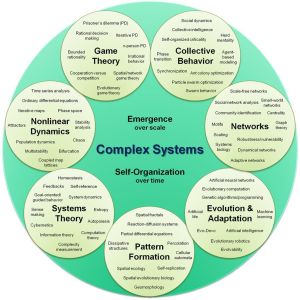
1024px-Complex_systems_organizational_map1280px-Complexity_Map.svg 

Science As a New Tower of 'Babble'
Complexity - a patchwork quilt of misunderstanding and confusion tied together 'by hook or by crook'.
https://en.wikipedia.org/wiki/By_hook_or_by_crook

Complex systems are the result of our collective blindness to the simple interconnectedness of our universe.

Why is the emerging view of our universe - no longer a Cosmological and Cosmogonic garden of the good, true and beautiful - now turning into this phantasm of complexity?

Where did we go wrong?
Was it the creation and maintaining of the expectation that we could comprehend and grasp the whole of our Cosmos within one perspective?

Were the applications of the science we created so profit bearing that we began to take more than our fare share?

Was it the tempo at which our scientists - not even slowed down by the ethical and moral considerations which constitute our navigation systems down the roads of evolution - that have brought us to this place much too soon and with so much needless suffering (for animals and humans)?

Are we to continue abandoning our organic (and real) ascendancy for artificial (and synthetic) correlates?

The ends are NOT justified by their means! They are determined by them.

https://en.wikipedia.org/wiki/Complex_systems

#Knowledge #Wisdom #Understanding #Learning #Insight #Awaken #AwakenNow #Trendy #AI #OI #ArtificialIntelligence #OrganicIntelligence #ScienceRunAmok #TechnologyRunAmok
Image1:
Hiroki Sayama, D.Sc. - Created by Hiroki Sayama, D.Sc., Collective Dynamics of Complex Systems (CoCo) Research Group at Binghamton University, State University of New York

Image2:
By Brian Castellani (Own work) [CC BY-SA 3.0 (http://creativecommons.org/licenses/by-sa/3.0)], via Wikimedia Commons

Saturday, 13 December 2014

Universal Constants and Variances


Universal Constants and Variances  
#1 Awareness is primary and fundamental. (Substrate) #2 All awareness is non-dual unless it is dual. (Duality) #3 There is no inside without an outside nor outside without an inside. (Interiority/Exteriority) #4 Duality is bounded, non-duality is boundless. (Boundary) #5 Boundaries arise in a spectrum from diffuse to concise. (Crossing)

[More are coming soon in a new post...]

A few of those who follow my posts have been asking for more information about my work. Towards that end, I'm going to start publishing my growing list of universal constants and variances. It is these constants and variances that form the foundation of my work.
There are about as many of them as there are stars in our universe (if you count the primary and derived together), so I don't think I'll run out of them! Most of them are self-explanatory, but if you have any questions, please don't hesitate to ask in the appropriate thread. The numerical ordering is not yet important, as I'm still collecting and collating them as I discover them.

I have no tolerance for trolling or people who abuse others in my threads; especially on these threads about the constants and variances! So if you plan to wreak havoc here, you'll get bumped real fast. I don't mind criticism or skeptical opinions at all, but please be civil with everyone (including me).

See http://mathesis-universalis.com for more information.

Monday, 25 August 2014

A Precise Definition of Knowledge - Knowledge Representation as a Means to Define the Meaning of Meaning Precisely

A Precise Definition of Knowledge
Knowledge Representation as a Means to Define the Meaning of Meaning Precisely
Copyright © Carey G. Butler
August 24, 2014

What is this video about?
In this introductory video I would like to explain what knowledge representation is, how to build and apply them. There are basically three phases involved in the process of building a knowledge representation. Acquisition of data (which includes staging), collation and the representation itself. The collation and the representation phases of the process are mentioned here, but I will explain them further in future videos.

You are now watching a simulation of the acquisition phase as it collects and stores preliminary structure from the data it encounters in terms of the vocabulary contained within that data. Acquisition is a necessary prerequisite for the collation phase following it, because the information it creates from the data are used by the collation algorithms which then transform that information into knowledge.

The statistics you are seeing tabulated are only a small subset of those collected in a typical acquisition phase. Each of these counters are being updated in correspondence to the recognition coming from underlying parsers running in the background. Depending upon the computer resources involved in the
acquisition, these parsers may even even run concurrently as is shown in this simulation.

The objects you see moving around in the video are of two different kinds: knowledge fields or knowledge molecules. Those nearest to you are the field representations of the actual data being collected called knowledge fields. They could represent an individual symbol, punctuation, morpheme, lexeme, word, emotion, perspective, or some other unit of information in the data. Each of them contain their own signature – even if their value, state or other intrinsic properties are unknown or indeterminate during the acquisition.

Those farther away from the view are clusters of fields which have already coalesced into groups according to shared dynamically adaptive factors such as similarity, relation, cardinality, ordinality,... These 'molecules' also contain their own set of signatures and may be composed of a mixture of fields, meta-fields and hyper-fields that are unique to all others.The collation phase has the job of assigning these molecules to their preliminary holarchical domains which are then made visible in the resulting knowledge representation. Uniqueness is preserved even if they contain common elements with others in the domain they occupy. Clusters of knowledge molecules and/or fields grouped together are known as 'knowledge domains', 'structural domains','dynamical domains' or 'resonance domains', depending upon which of their aspects is being emphasized.

We now need a short introduction to what knowledge representation is in order to explain why you're seeing these objects here.

What is Knowledge Representation?
Knowledge representation provides all of the ways and means necessary to reliably and consistently conceptualize our world. It helps us navigate landscapes of meaning without losing our way; however, navigational bearing isn't the only advantage. Knowledge representation aids our recognition of what changes when we change our world or something about ourselves. It does so, because even our own perspective is included in the representation. It can even reveal to us when elements are missing or hidden from our view!

It's important to remember that knowledge representation is not an end, rather a means or process that makes explicit to us everything we already do with what we come to be aware of. A knowledge representation must be capable of representing knowledge such that it, like a book or other artifact, brings awareness of that knowledge  to us. When we do it right, it actually perpetuates our understanding by providing a means for us to recognize, interpret (understand) and utilize the how and what we know as it relates to itself and to us. In fact – knowledge representation even makes it possible to define knowledge precisely!

What Knowledge is not!
Knowledge is not very well understood so I'll briefly point out some of the reasons why we've been unable to precisely define what  knowledge is thus far. Humanity has made numerous attempts at defining knowledge. Plato taught that justified truth and belief are required for something to be considered knowledge. Throughout the history of the theory of knowledge (epistemology), others have done their best to add to Plato's work or create new or more comprehensive definitions in their attempts to 'contain' the meaning of meaning (knowledge). All of these efforts have failed for one  reason or another. Using truth value and justification as a basis for knowledge or introducing broader definitions or finer classifications can only fail. I will now provide a small set of examples of why this
is so.

Truth value is only a value that knowledge may attend. Knowledge can be true or false, justified or unjustified, because knowledge is the meaning of meaning. What about false or fictitious knowledge? Their perfectly valid structure and dynamics are ignored by classifying them as something else than what they are. Differences in culture or language make even make no difference, because the objects being referred to have meaning that transcends language barriers.

Another problem is that knowledge is often thought to be primarily semantics or even ontology based! Both of these cannot be true for many reasons. In the first case (semantics): There already exists knowledge structure and dynamics for objects we cannot or will not yet know. The same is true for objects to which meaning has not yet been assigned,such as ideas, connections and perspectives that we're not yet aware of or have forgotten. Their meaning is never clear until we've become aware of or remember them.

In the second case (ontology): collations that are fed ontological framing are necessarily bound to memory, initial conditions of some kind and/or association in terms of space, time, order, context, relation,... We build whole catalogs, dictionaries and theories about them! Triads, diads, quints, ontology charts, neural networks, semiotics and even the current research in linguistics are examples.
Even if an ontology or set of them attempts to represent intrinsic meaning, it can only do so in a descriptive (extrinsic) way.

An ontology, no matter how sophisticated, is incapable of generating the purpose of even its own inception, not to mention the purpose of objects to which it corresponds!

The knowledge is not coming from the data itself, it's always coming from the observer of the data – even if that observer is an algorithm!

Therefore ontology-based semantic analysis can only produce the artifacts of knowledge, such as search results, association to other objects, 'knowledge graphs' like Cayley,.. Real knowledge precedes, transcends and includes our conceptions, cognitive processes, perception, communication, reasoning and is more than simply related to our capacity of acknowledgment. In fact knowledge cannot even be completely systematized, it can only be interacted with using ever increasing precision!

What is knowledge then?
• Knowledge is what awareness does.
• Awareness of some kind and at some level is the only prerequisite for knowledge and is the substrate upon which knowledge is generated.
• Awareness coalesces, interacts with and perpetuates itself in all of its form and function.
• Awareness which resonates (shares dynamics) at, near, or in some kind of harmony (even disharmony) with another tends to associate (disassociate) with that other in some way.
• These requisites of awareness hold true even for objects that are infinite or indeterminate.
• This is why knowledge, the meaning of meaning, can be precisely defined and even provides its own means for doing so.
• Knowledge is, pure and simply: the resonance, structure and dynamics of awareness as it creates and discovers for and of itself.
• Awareness precedes meaning and provides the only fundamentally necessary and sufficient basis for meaning of meaning expressing itself as knowledge.
• Knowledge is the dialog between participants in awareness – even if that dialog appears to be only one-way, incoherent or incomplete.
• Even language, mathematics, philosophy, symbolism, analogy, metaphor and sign systems can all be resolved to this common denominator found at the foundation of each and every one of them.

More information about the objects seen:
The objects on the surface of the pyramid correspond to basic structures denoting some of the basic paradigms that are being used to mine data into information and then collate that information into knowledge. You may notice that their basic structures do not change, only their content does. These paradigms are comprised of contra-positional fields that harmonize with each other so closely that they build complete harmonic structures. Their function is similar to what proteins and enzymes do in our cells.

#Knowledge #Wisdom #Understanding #Learning #Insight #Semantics #Ontology #Epistemology #Philosophy #PhilosophyOfLanguage #PhilosophyOfMind #Cognition #OrganicIntelligence #ArtificialIntelligence #OI #AI
#Awareness
https://www.academia.edu/8066040/A_Precise_Definition_of_Knowledge_-_Knowledge_Representation_as_a_Means_to_Define_the_Meaning_of_Meaning_Precisely