No.
Here an excerpt from a short summary of a paper I am writing that provides some context to answer this question:
What Knowledge is not:
Knowledge
is not very well understood so I'll briefly point out some of the
reasons why we've been unable to precisely define what knowledge is thus
far. Humanity has made numerous attempts at defining knowledge. Plato taught that justified truth and belief are required for something to be considered knowledge.
Throughout
the history of the theory of knowledge (epistemology), others have done
their best to add to Plato's work or create new or more comprehensive
definitions in their attempts to 'contain' the meaning of meaning
(knowledge). All of these efforts have failed for one reason or another.
Using
truth value and 'justification’ as a basis for knowledge or introducing
broader definitions or finer classifications can only fail.
I will now provide a small set of examples of why this is so.
Truth value is only a value that knowledge may attend.
Knowledge can be true or false, justified or unjustified, because
knowledge is the meaning of meaning
What about false or fictitious knowledge? [Here’s the reason why I say no.]
Their
perfectly valid structure and dynamics are ignored by classifying them
as something else than what they are. Differences in culture or language
even make no difference, because the objects being referred to have
meaning that transcends language barriers.
Another problem is
that knowledge is often thought to be primarily semantics or even
ontology based. Both of these cannot be true for many reasons. In the
first case (semantics):
There already exists knowledge structure and dynamics for objects we cannot or will not yet know.
The
same is true for objects to which meaning has not yet been assigned,
such as ideas, connections and perspectives that we're not yet aware of
or have forgotten. Their meaning is never clear until we've become aware
of or remember them.
In the second case (ontology): collations
that are fed ontological framing are necessarily bound to memory,
initial conditions of some kind and/or association in terms of space,
time, order, context, relation,... We build whole catalogues,
dictionaries and theories about them: Triads, diads, quints, ontology
charts, neural networks, semiotics and even the current research in
linguistics are examples.
Even if an ontology or set of them attempts to represent intrinsic meaning, it can only do so in a descriptive ‘extrinsic’ way. An
ontology, no matter how sophisticated, is incapable of generating the
purpose of even its own inception, not to mention the purpose of the
objects to which it corresponds.
The knowledge is not coming
from the data itself, it is always coming from the observer of the data,
even if that observer is an algorithm.
Therefore ontology-based
semantic analysis can only produce the artefacts of knowledge, such as
search results, association to other objects, 'knowledge graphs' like
Cayley,…
Real knowledge precedes, transcends and includes
our conceptions, cognitive processes, perception, communication,
reasoning and is more than simply related to our capacity of
acknowledgement.
In fact knowledge cannot even be completely systematised; it can only be interacted with using ever increasing precision.
[For
those interested, my summary is found at: A Precise Definition of
Knowledge - Knowledge Representation as a Means to Define the Meaning of
Meaning Precisely: http://bit.ly/2pA8Y8Y
Thursday, 11 May 2017
Is Real World Knowledge More Valuable Than Fictional Knowledge?
Wednesday, 10 May 2017
Does Knowledge Become More Accurate Over Time?
Change lies deeper in the knowledge substrate than time.
Knowledge is not necessarily coupled with time, but it can be influenced by it. It can be influenced by change of any kind: not only time.
Knowledge may exist in a moment and vanish. The incipient perspective(s) it contains may change. Or the perspective(s) that it comprises may resist change.
Also, knowledge changes with reality and vice versa.
Time requires events to influence this relationship between knowledge and reality.
Knowledge cannot be relied upon to be a more accurate expression of reality, whether time is involved or not, because the relationship between knowledge and reality is not necessarily dependent upon time, nor is there necessarily a coupling of the relationship between knowledge and reality. The relationships of 'more’ and ‘accurate' are also not necessarily coupled with time.
Example: Eratosthenes calculated the circumference of the Earth long before Copernicus published. The ‘common knowledge’ of the time (Copernicus knew about Eratosthenes, but the culture did not) was that the Earth was flat.
Sunday, 7 May 2017
Is Mathematics Or Philosophy More Fundamental?
Answer: Philosophy is more fundamental than mathematics.
This is changing, but mathematics is incapable at this time of comprehensively describing epistemology, whereas, philosophy can.
Hence; mathematics is restrained to pure ontology. It does not reach far enough into the universe to distinguish anything other than ontologies. This will change soon. I am working on exactly this problem. See http://mathematica-universalis.com for more information on my work. (I’m not selling anything on this site.)
Also, mathematics cannot be done without expressing some kind of philosophy to underlie any axioms which it needs to function.
PROOF:
Implication is a ‘given’ in mathematics. It assumes a relation which we call implication. Mathematics certainly ‘consumes’ them as a means to create inferences, but the inference form, the antecedent, and the consequent are implicit axioms based upon an underlying metaphysics.
Ergo: philosophy is more general and universal than mathematics.
Often epistemology is considered separate from metaphysics, but that is incorrect, because you cannot answer questions as to ‘How do we know?” without an underlying metaphysical framework within which such a question and answer can be considered.
What About Tacit Knowledge?
A knowledge representation system is required. I’m building one right now. Mathesis Universalis.
There are other tools which are useful, such as TheBrain Mind Mapping Software, Brainstorming, GTD and Knowledgebase Software
Products and technologies like TheBrain, knowledge
graphs, taxonomies, and thesauri can only manage references to and
types of knowledge (ontologies).
A true knowledge representation would contain
vector components which describe the answers to “Why?” and “How does one
know?” or “When is ‘enough’, enough?” (epistemology).
It is only through additional epistemological representation that tacit knowledge can be stored and referenced.
Monday, 31 August 2015
A Holon's Topology, Morphology, and Dynamics (2a)
This is the second video of a large series and the very first video in a mini-series about holons. In this series I will be building the vocabulary of holons which in turn will be used in my knowledge representations.
The video following this one will go into greater detail describing what you see here and will be adding more to the vocabulary.
This is the second video of a large series and the very first video in a mini-series about holons. In this series I will be building the vocabulary of holons which in turn will be used in my knowledge representations.
#Knowledge #Wisdom #Understanding #Insight #Learning #MathesisUniversalis #ScientiaUniversalis #Holons #BigData
This is the second video of a large series and the very first video in a mini-series about holons. In this series I will be building the vocabulary of holons which in turn will be used in my knowledge representations.
The video following this one will go into greater detail describing what you see here and will be adding more to the vocabulary.
This is the second video of a large series and the very first video in a mini-series about holons. In this series I will be building the vocabulary of holons which in turn will be used in my knowledge representations.
#Knowledge #Wisdom #Understanding #Insight #Learning #MathesisUniversalis #ScientiaUniversalis #Holons #BigData
Tuesday, 3 February 2015
Science As a New Tower of 'Babble'

Science As a New Tower of 'Babble'
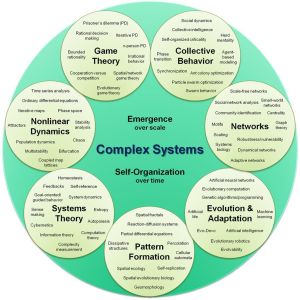
Complexity - a patchwork quilt of misunderstanding and confusion tied together 'by hook or by crook'.
https://en.wikipedia.org/wiki/By_hook_or_by_crook
Complex systems are the result of our collective blindness to the simple interconnectedness of our universe.
Why is the emerging view of our universe - no longer a Cosmological and Cosmogonic garden of the good, true and beautiful - now turning into this phantasm of complexity?
Where did we go wrong?
Was it the creation and maintaining of the expectation that we could comprehend and grasp the whole of our Cosmos within one perspective?
Were the applications of the science we created so profit bearing that we began to take more than our fare share?
Was it the tempo at which our scientists - not even slowed down by the ethical and moral considerations which constitute our navigation systems down the roads of evolution - that have brought us to this place much too soon and with so much needless suffering (for animals and humans)?
Are we to continue abandoning our organic (and real) ascendancy for artificial (and synthetic) correlates?
The ends are NOT justified by their means! They are determined by them.
https://en.wikipedia.org/wiki/Complex_systems
#Knowledge #Wisdom #Understanding #Learning #Insight #Awaken #AwakenNow #Trendy #AI #OI #ArtificialIntelligence #OrganicIntelligence #ScienceRunAmok #TechnologyRunAmok Image1:
Hiroki Sayama, D.Sc. - Created by Hiroki Sayama, D.Sc., Collective Dynamics of Complex Systems (CoCo) Research Group at Binghamton University, State University of New York
Image2:
By Brian Castellani (Own work) [CC BY-SA 3.0 (http://creativecommons.org/licenses/by-sa/3.0)], via Wikimedia Commons
Saturday, 13 December 2014
Universal Constants and Variances
#1 Awareness is primary and fundamental. (Substrate) #2 All awareness is non-dual unless it is dual. (Duality) #3 There is no inside without an outside nor outside without an inside. (Interiority/Exteriority) #4 Duality is bounded, non-duality is boundless. (Boundary) #5 Boundaries arise in a spectrum from diffuse to concise. (Crossing)
[More are coming soon in a new post...]
A few of those who follow my posts have been asking for more information about my work. Towards that end, I'm going to start publishing my growing list of universal constants and variances. It is these constants and variances that form the foundation of my work.
There are about as many of them as there are stars in our universe (if you count the primary and derived together), so I don't think I'll run out of them! Most of them are self-explanatory, but if you have any questions, please don't hesitate to ask in the appropriate thread. The numerical ordering is not yet important, as I'm still collecting and collating them as I discover them.
I have no tolerance for trolling or people who abuse others in my threads; especially on these threads about the constants and variances! So if you plan to wreak havoc here, you'll get bumped real fast. I don't mind criticism or skeptical opinions at all, but please be civil with everyone (including me).
See http://mathesis-universalis.com for more information.
Subscribe to:
Comments (Atom)